Bulgaria's Rose Valley: A Fragrant Tradition of Picking and Distilling
Each May and June, the fields around Kazanlak and Karlovo turn pink as Bulgaria's famous Damask rose blooms. Learn about the rose-picking tradition that has shaped local culture for centuries.
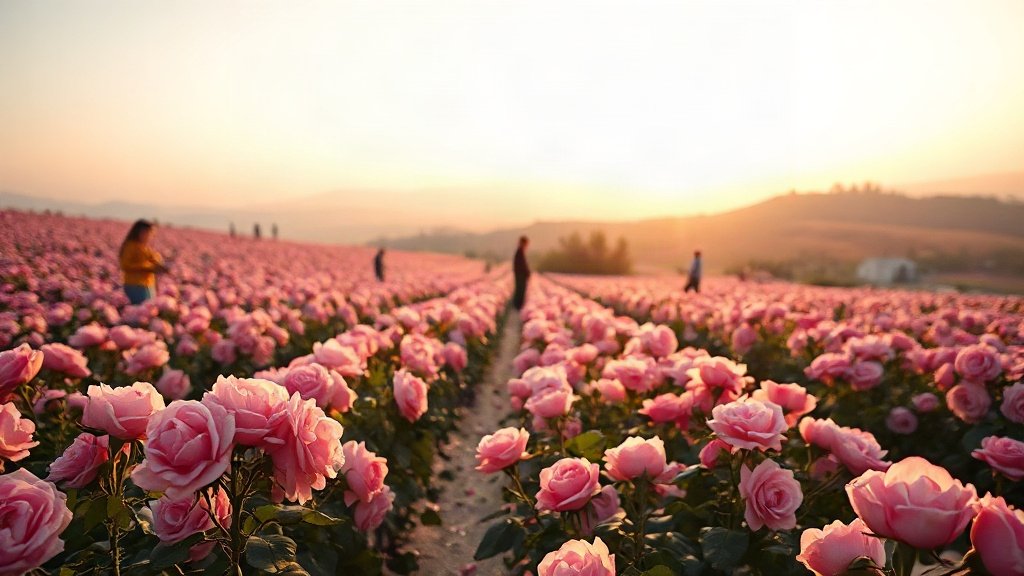
Illustration: AI-generated image
When the first light touches the valley between the Balkan Mountains and Sredna Gora, whole families are already out in the rose fields. It is late May, and for a few short weeks the air around Kazanlak and Karlovo is thick with the scent of Damask roses. This is Bulgaria's Rose Valley, and the annual harvest is both a livelihood and a living tradition.
A Flower with Deep Roots
The Damask rose (Rosa damascena) is not native to Bulgaria, but it has found a second home here. It is believed to have arrived from the Middle East via Ottoman trade routes, and by the 17th century the region around Kazanlak had become a centre of rose cultivation. The local climate — mild winters, warm summers and well-drained soils — proved ideal for the shrub, and the essential oil produced here soon gained a reputation for its exceptional quality.
Today Bulgaria is among the world's largest producers of rose oil, and the tradition remains remarkably unchanged. The harvest is still done by hand, often by the same families whose grandparents and great-grandparents worked the same plots.
The Ritual of Picking
Rose picking begins at dawn, usually around 5 a.m., and finishes by late morning. The flowers must be gathered while the dew is still on the petals; this is when the oil content is highest and the fragrance most intense. Pickers move quickly down the rows, gently twisting each bloom between thumb and forefinger and dropping it into a canvas bag tied at the waist. An experienced picker can gather 20 to 30 kilograms of petals in a morning, but it takes roughly 3,000 kilograms of petals to produce one kilogram of rose oil.
The work is fast and repetitive, yet there is a quiet beauty to it. The fields hum with conversation and laughter, and children often help after school. For many locals, the rose harvest is a moment of community, a break from the routine of village life that connects them to the land and to each other.
From Petals to Perfume
Once picked, the petals are rushed to a distillery. Speed is essential: if left too long, the petals ferment and the oil loses its quality. In the traditional method, petals are placed in copper stills with water and heated slowly. Steam carries the essential oil into a condenser, where it separates into rose oil and rose water. Some distilleries still use wood-fired stills, and the process is watched over by a master distiller who decides exactly when to stop — a skill passed down through generations.
The resulting oil, often called "liquid gold," is used in high-end perfumery, cosmetics and even medicine. Rose water, a by-product, is used in cooking, religious rituals and as a gentle skin tonic. Many families keep a small bottle at home for special occasions.
A Cultural Emblem
The rose is more than an agricultural product in Bulgaria. It appears in folk songs, embroidery patterns and woodcarvings. During the harvest season, villages hold small celebrations with music, dancing and food, and the rose itself is a symbol of beauty, love and resilience. The tradition has been recognised by UNESCO as part of humanity's intangible cultural heritage, affirming its importance not just to the region but to the world.
For a visitor, the Rose Valley in late May is an unforgettable sight: endless stripes of pink and green, the buzz of bees, and the chance to pick a few petals yourself. It is a reminder that some traditions survive not because they are preserved in museums, but because they still make sense to the people who live them.