Devil's Bridge: A Guide to Bulgaria's Ottoman Marvel in the Rhodopes
Cross a stone arch that has stood for centuries over the Arda River. Here's how to reach Bulgaria's legendary Devil's Bridge and what to see along the way.
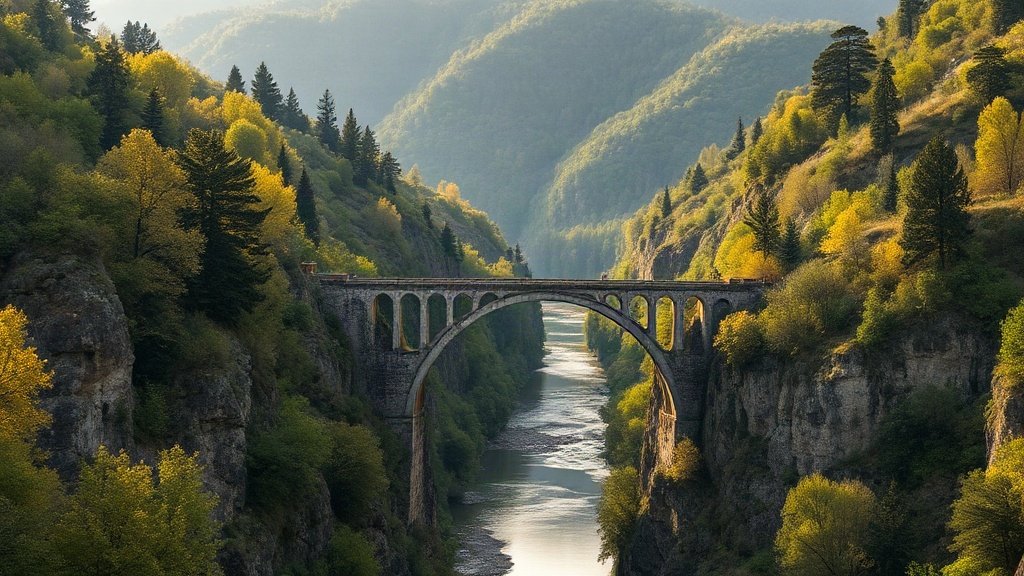
Illustration: AI-generated image
Hidden in a forested gorge of the Rhodope Mountains, Devil's Bridge (Dyavolski most in Bulgarian) is an extraordinary piece of Ottoman engineering that still carries walkers over the Arda River more than four centuries after it was built. The single-arch stone crossing rises dramatically above the water, its reflection shimmering in the deep pool below. It's a superb destination for hikers, history lovers and anyone seeking a dramatic photo.
Where is Devil's Bridge?
The bridge lies in the southern part of Bulgaria, in the eastern Rhodopes, about 10 kilometres from the town of Ardino in Kardzhali Province. It spans the Arda River at a point where the valley narrows into a steep, rocky gorge. The closest major city is Plovdiv, roughly two hours away by car.
A Legendary Pact
Like many old bridges in the Balkans, Devil's Bridge comes with a dark folk tale. According to local legend, the master builder struggled to complete the arch because the river kept washing away his work. In desperation, he made a pact with the devil: if the bridge stood, the devil could take the first living soul to cross it. On the day of completion, the builder sent a dog across first, cheating the devil. Furious, the devil stamped his face into the stone, which can still be seen today—a shadowy imprint on one of the arch stones. Whether or not you believe the story, the atmosphere around the bridge is undeniably mystical.
Visiting the Bridge
The most rewarding way to reach the bridge is on foot. A well-marked eco trail begins at the edge of Ardino and descends through oak and beech forest, following the river for about two kilometres. The walk takes 30–45 minutes each way, with a few steep sections and wooden stairs. Sturdy shoes are recommended. At the bottom, the gorge opens up to reveal the bridge in a dramatic setting. In spring and early summer, the surrounding greenery is especially lush, and the river runs high.
If you prefer to drive, a narrow asphalt road leads to a small parking area near the bridge, but the final approach is still on foot. The site is open year-round, though access may be slippery after heavy rain or snow.
A Feat of Engineering
The bridge is a fine example of Ottoman stonework, built from locally quarried blocks fitted together with remarkable precision. Its single arch is both graceful and strong, and it rises impressively above the water below. A low stone parapet runs along both sides. Construction likely dates to the 16th century, when such bridges were vital for trade and travel across the rugged Rhodope terrain.
What Else to See Nearby
Devil's Bridge is a good starting point for exploring the eastern Rhodopes, a region famous for its rugged landscapes and Thracian heritage. The ancient rock sanctuary of Perperikon is about an hour's drive away, and the stone town of Tatul, another Thracian site, is also within reach. For a more relaxing break, the town of Ardino has a small ethnographic museum and several traditional restaurants serving local Rhodope dishes like cheverme (slow-roasted lamb) and patatnik (potato pie).
Whether you come for the legend, the hike or the pure beauty of stone and water, Devil's Bridge is one of Bulgaria's most memorable off-the-beaten-path sights.