Beglik Tash: a guide to Bulgaria's ancient Thracian sanctuary
Megalithic stone circles and sun-warmed rocks overlook the Black Sea at this enigmatic Bronze Age site near Primorsko.
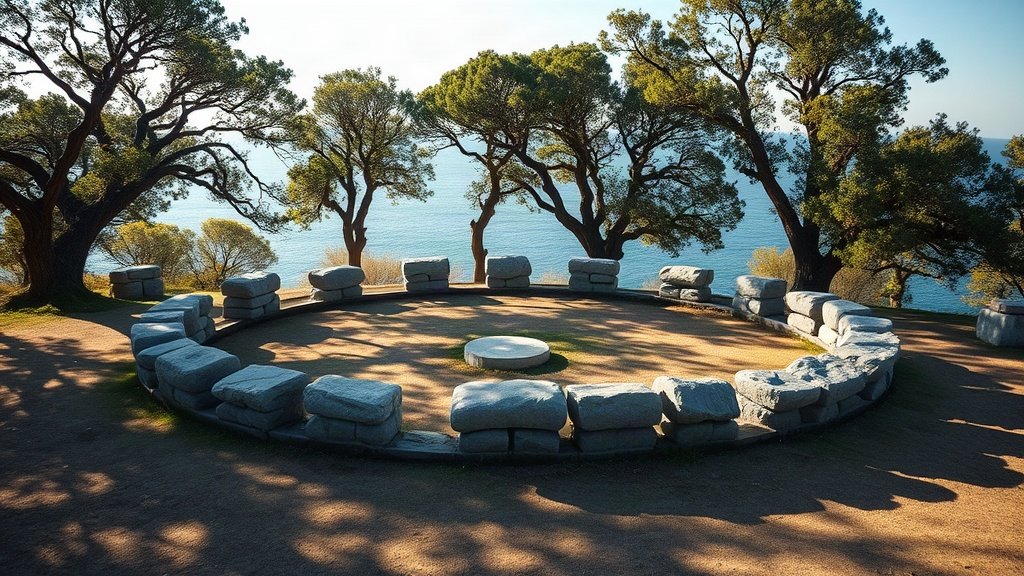
Illustration: AI-generated image
Hidden among oak forests on a headland above the Black Sea, Beglik Tash is one of Bulgaria's most intriguing ancient sites. This open-air sanctuary of rough-hewn megaliths dates back to the late Bronze Age and early Iron Age, offering a rare glimpse into the ritual life of the Thracians.
Where it is and how to get there
Beglik Tash lies about five kilometres south of the small seaside town of Primorsko, on the southern Bulgarian coast. A signposted turn-off from the main coastal road leads to a parking area, from which a wide forest path climbs gently for roughly 20 minutes to the site. The route is well-trodden and suitable for most visitors, though sturdy shoes are recommended. If you are staying in Primorsko, you can also walk or take a taxi to the trailhead.
What to see
The sanctuary covers a broad, sunlit meadow ringed by ancient oaks. At its heart stands a large circle of upright stones, some weighing several tonnes, arranged with astronomical precision. Nearby lie a flat altar stone, a rock known as the 'marriage bed', and a carved 'throne' cut into the living rock. Archaeologists believe the site was used for sun worship and fertility rites, with the stone circle aligned to the summer solstice. From the plateau, you can see the sea glinting beyond the treetops, a view that must have felt sacred to those who gathered here millennia ago.
Practical tips for your visit
- The site is exposed, with little shade, so bring water and sun protection.
- Allow at least an hour to explore the stones and the surrounding forest paths.
- Combine your visit with a swim at Primorsko's beaches or a boat trip on the nearby Ropotamo River.
- The sanctuary is free to enter, but access may be restricted in very bad weather.
When to go
Late spring and early autumn are ideal, when the days are warm but not overwhelming and the forest is at its greenest. Summer brings more visitors, but the site rarely feels crowded. Winter can be chilly and the path muddy, so check conditions before setting out.