The Tapan: Bulgaria's Thundering Folk Drum
From wedding horos to village festivals, the deep rolling beat of the tapan drives Bulgaria's folk music. Here's how to recognise it and why it matters.
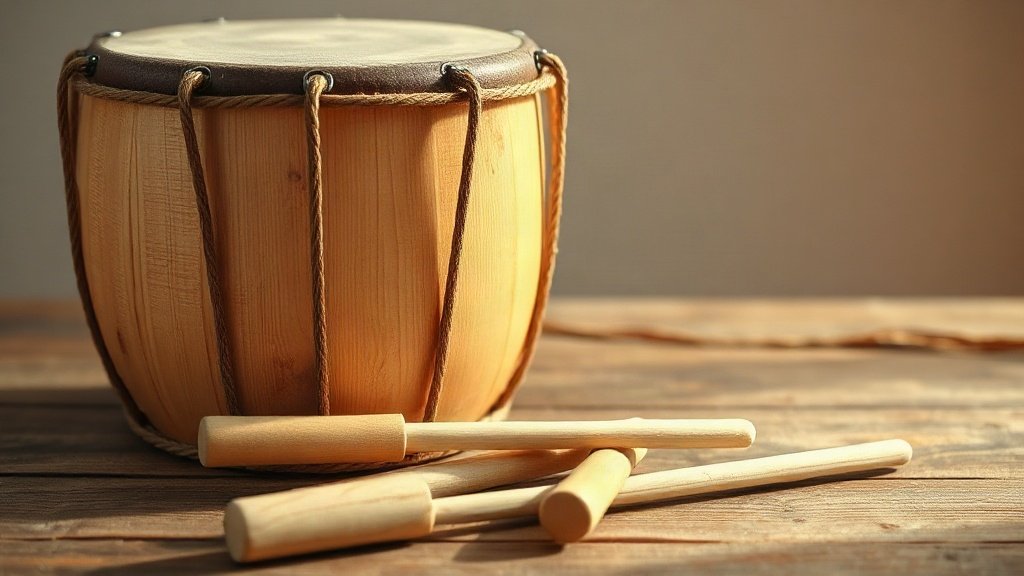
Illustration: AI-generated image
When a Bulgarian folk band strikes up, the first sound that often grabs you is the deep, rolling thunder of the tapan. This large double-headed drum has been the backbone of village celebrations for centuries, providing the irresistible pulse that makes feet start moving in a horo.
What is the tapan?
The tapan is a cylindrical drum with two heads, usually made from goat or sheep skin stretched over a hollow wooden body. Traditionally the body is carved from a single piece of walnut, beech or other hardwood, giving the drum its warm, resonant tone. The two heads are laced together with rope or leather tension cords, and by tightening or loosening these cords the player can adjust the pitch and tightness of the sound.
Unlike a modern drum kit, the tapan is not played with manufactured drumsticks. Instead it uses two very different beaters: a thick wooden mallet called a kijak for the main beating head, and a thin flexible switch called a pracka for the opposite head. This combination allows the drummer to produce both deep, booming bass notes and sharp, crisp accents from a single drum.
How the tapan is played
Most tapan players wear the drum slung over one shoulder or across the body, leaving both hands free while they stand or walk. The thick beater strikes the main skin to create the low, driving beat, while the thin switch snaps against the other head to add quick ornamental strokes. Because the two heads have different tensions and are struck with different tools, the tapan can mimic a conversation between a bass drum and a snare drum.
Bulgarian folk music is famous for its complex, irregular time signatures, and the tapan is central to keeping those rhythms alive. A skilled player locks into patterns of 7/8, 9/8 or 11/8, weaving syncopations that push the dancers forward. The tapan often works closely with the gaida (bagpipe), kaval (end-blown flute) and gadulka (bowed string instrument), but in many village traditions it is the tapan that sets the tempo for the whole ensemble.
Where you can hear it
You will hear the tapan at almost every Bulgarian folk event, from village weddings and baptisms to large festivals such as the Koprivshtitsa National Festival of Folklore. It drives the circular horo dance at outdoor gatherings and provides dramatic punctuation during the lively rachenitsa. In some regions of the Rhodope Mountains and Thrace, solo tapan performances are a highlight, with drummers showing off virtuosic rolls and cross-rhythms.
Even at smaller celebrations in town squares or chitalishta (community culture centres), a tapan player is often at the heart of the music. If you are new to Bulgarian folklore, a good starting point is to watch how the drummer communicates with the dancers: a sudden double stroke can signal a change of step, a pause can bring the whole circle to a halt, and a thunderous roll can send everyone spinning.
A living tradition
Although modern drum kits and electronic instruments are common in popular music, the tapan remains irreplaceable in authentic Bulgarian folk performance. Young musicians continue to learn the instrument through community groups, folk ensembles and informal apprenticeships. The skills are passed down within families and villages, preserving a rich vocabulary of regional rhythms and personal styles.
For visitors, simply listening to a tapan up close is one of the most immediate ways to feel the energy of Bulgaria's musical heritage. The next time you hear a folk melody drifting across a village square, listen for the deep heartbeat underneath — that is the tapan, calling everyone to dance.





