Rila Monastery: Bulgaria's Spiritual Heart in the Mountains
A guide to Bulgaria's largest and most famous Orthodox monastery, its rich history, striking frescoes and serene mountain setting.
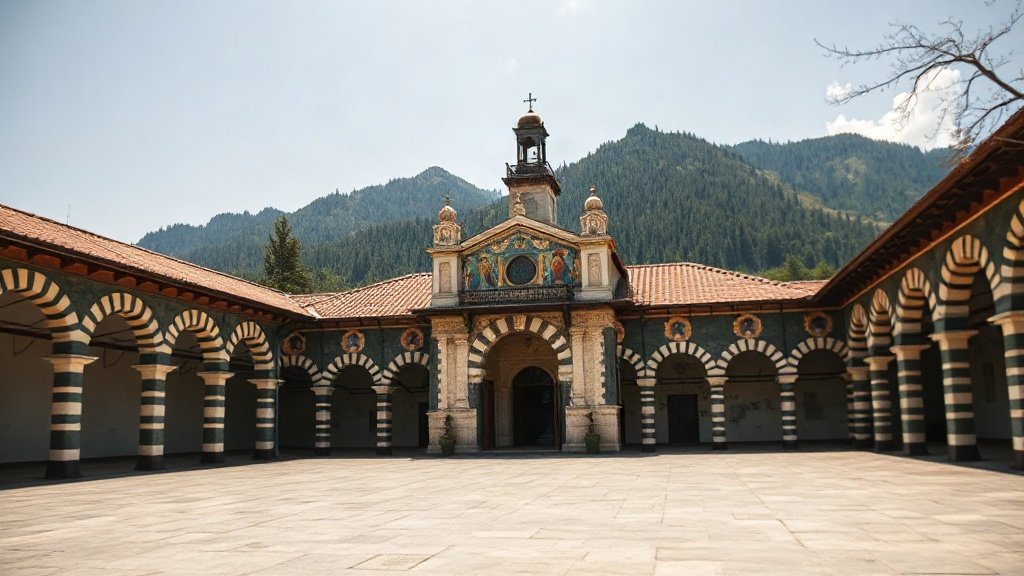
Illustration: AI-generated image
Hidden among the pine forests of the Rila Mountains, about 120 kilometres south of Sofia, stands Bulgaria's most revered spiritual and cultural landmark: Rila Monastery. Founded in the 10th century by the hermit Saint Ivan of Rila, the monastery has been a centre of Orthodox Christianity, learning and national identity for over a millennium. Today it remains an active monastery, a UNESCO World Heritage site and one of the country's most visited places.
A history of faith and resilience
The monastery's story begins with Saint Ivan of Rila, a hermit who lived in a cave nearby and whose reputation for holiness attracted followers. After his death in 946, his disciples built a community around his shrine. Over the centuries, the monastery was destroyed by fire and rebuilt several times, often with support from Bulgarian tsars and wealthy donors. Its current appearance dates largely from the early 19th century, when it was reconstructed after a devastating fire in 1833. This rebuilding coincided with the Bulgarian National Revival, a period when the monastery became a symbol of national consciousness and preserved Bulgarian language, literature and faith during Ottoman rule.
Architecture and art
The monastery is enclosed by massive stone walls that rise four storeys high, giving it the appearance of a fortress. Inside, a spacious cobbled courtyard centres on the main church, the Church of the Nativity of the Virgin. Its exterior is covered with vivid frescoes painted in the 1840s by some of the most celebrated artists of the Bulgarian Revival, including Zahari Zograf. The arcaded galleries and striped black-and-white arches are typical of the period and create a striking visual rhythm.
The church's interior is equally rich, with gilded iconostasis, intricate woodcarving and wall paintings that depict biblical scenes and the lives of saints. Adjacent to the church stands the five-storey Hrelyo Tower, built in the 14th century, which is the oldest surviving part of the complex. The monastery also houses a museum with a collection of rare manuscripts, icons, church plate and ethnographic objects, including the celebrated Rila Cross, a wooden cross carved with 140 miniature biblical scenes by a monk named Rafail over 12 years in the late 18th century.
Visiting the monastery
Rila Monastery is open to visitors throughout the year, though the mountain weather can be cold and snowy in winter. The journey from Sofia by road takes about two hours. Many visitors combine the trip with a walk to the cave of Saint Ivan, about a 45-minute hike uphill through forest, where the hermit is said to have lived and prayed. The monastery still functions as a religious community, so modest dress is expected: shoulders and knees should be covered. Photography is allowed in the courtyard and around the church exterior, but inside the church it is usually restricted. Those who wish to stay longer can find simple guest rooms within the monastery walls, which offer a rare chance to experience the site after the day-trippers have left.
For anyone interested in Bulgarian history, Orthodox art or mountain landscapes, Rila Monastery offers a profound insight into the country's cultural and spiritual identity. Its enduring beauty and quiet atmosphere make it a highlight of any visit to Bulgaria.